
COMING SOON: Registration will open in early 2027.
This course introduces medical educators to the foundational concepts, theories, and practical applications of validity in assessment. Through a progressive learning experience, participants will build an understanding of key validity concepts, including validity arguments, validity inferences, and validity evidence, and explore their role in developing trustworthy and defensible assessments. Learners will then apply these principles by constructing validity arguments for medical education assessments and examining how validity intersects with reliability and fairness. The course culminates in the evaluation of real-world assessments, equipping educators with the skills to identify threats to validity, interpret assessment evidence, and select appropriate assessment approaches for their educational goals. By the end of the course, learners will be prepared to design, evaluate, and use assessments that support meaningful and informed decisions about learner performance.
Learn More About Your Course Instructor
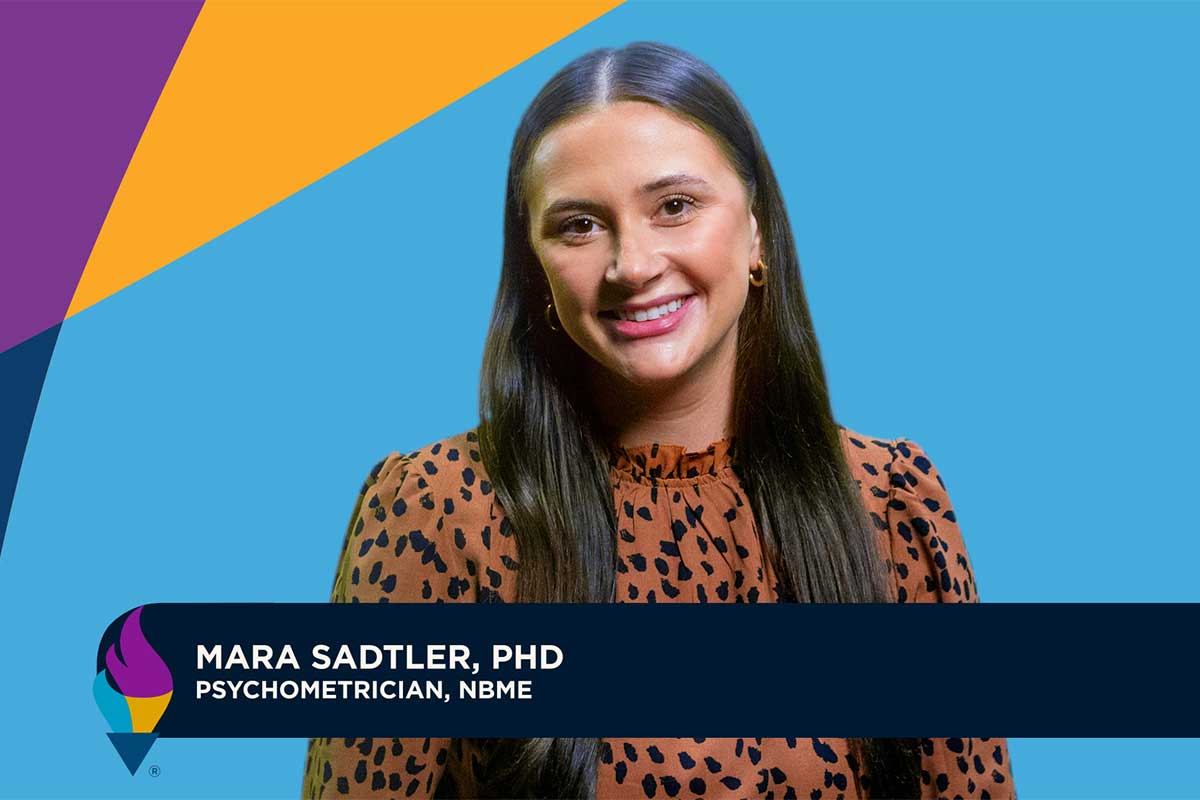
Mara Sadtler, Ph.D., is a Psychometrician in the Psychometrics and Data Analysis unit at NBME. Her expertise includes educational measurement, fairness in testing, longitudinal modeling of student learning, and the interpretation and use of assessment data. Dr. Sadtler's work has focused on supporting meaningful and appropriate interpretations and uses of assessment scores. She has experience applying a range of psychometric and statistical methods to support assessment research and practice, with an emphasis on translating complex measurement concepts for diverse audiences. She has presented her work at national and international conferences and published research on topics related to longitudinal measurement of student learning, examinee motivation, and educational policy.
Learning Goals
- Interpret assessment scores, performance metrics, and data visualizations commonly presented in score reports and dashboards.
- Evaluate assessment results within the appropriate context by considering benchmarks, score distributions, reliability, and sources of measurement uncertainty.
- Distinguish evidence-based conclusions from unsupported interpretations when reviewing assessment data.
- Apply a systematic framework for using assessment information to answer educational questions and support decision-making.
- Communicate assessment findings clearly and responsibly to support learner development, program evaluation, and curricular improvement.
More to Discover
Join our educator community, explore assessment research fellowship opportunities, and see how your peers are innovating assessment best practices.
