

Eight ambitious medical educators relish the rigors of the NBME Strategic Educators Enhancement Fellowship, surprising even themselves with the new sense of purpose they’ve gained along the way.
The fellows from the NBME Strategic Educators Enhancement Fellowship (SEEF) were undeniably giddy the first time they met. One of their mentors described their collective energy as “palpable.”
A year-and-a-half later, some of the eight junior faculty members have traveled across the country to visit another Fellow during the months between in-person meetings at NBME’s offices in Philadelphia. They’ve presented at national conferences together, counseled each other on career development and celebrated finding their professional “community.”
While it seems obvious to them that they’ll remain lifelong collaborators, they’re only beginning to process the other meaningful ways they’ve grown through this fellowship and the effect this maturation will have on their careers. At least this much is clear: The fellowship has provided them with clarity and, in many cases, a new sense of purpose.
Christopher Nash, MD, EdM, has trained extensively and earned multiple graduate degrees. He loves where he works and the people he works with. But he applied for this fellowship feeling like he had yet to find his true community of practice.
“I felt like I had developed a whole lot of knowledge, and I had some interests, but I didn’t have a group of people to work with,” Nash says. “I was hoping I’d get that out of this fellowship, and that’s exactly what I’ve gotten. I’ve met a lot of people who want to have the same rigor that I want to have and who have pushed me to be better.”
Because of that, he says the NBME SEEF has been “the single most important professional development opportunity” he’s had.
‘The missing piece that I didn’t know was missing’
The fellowship enables researchers and medical educators early in their careers to collaborate on research projects with NBME assessment experts and faculty mentors. This cohort, the program’s second, began its fellowship in June 2024 and concludes next June.
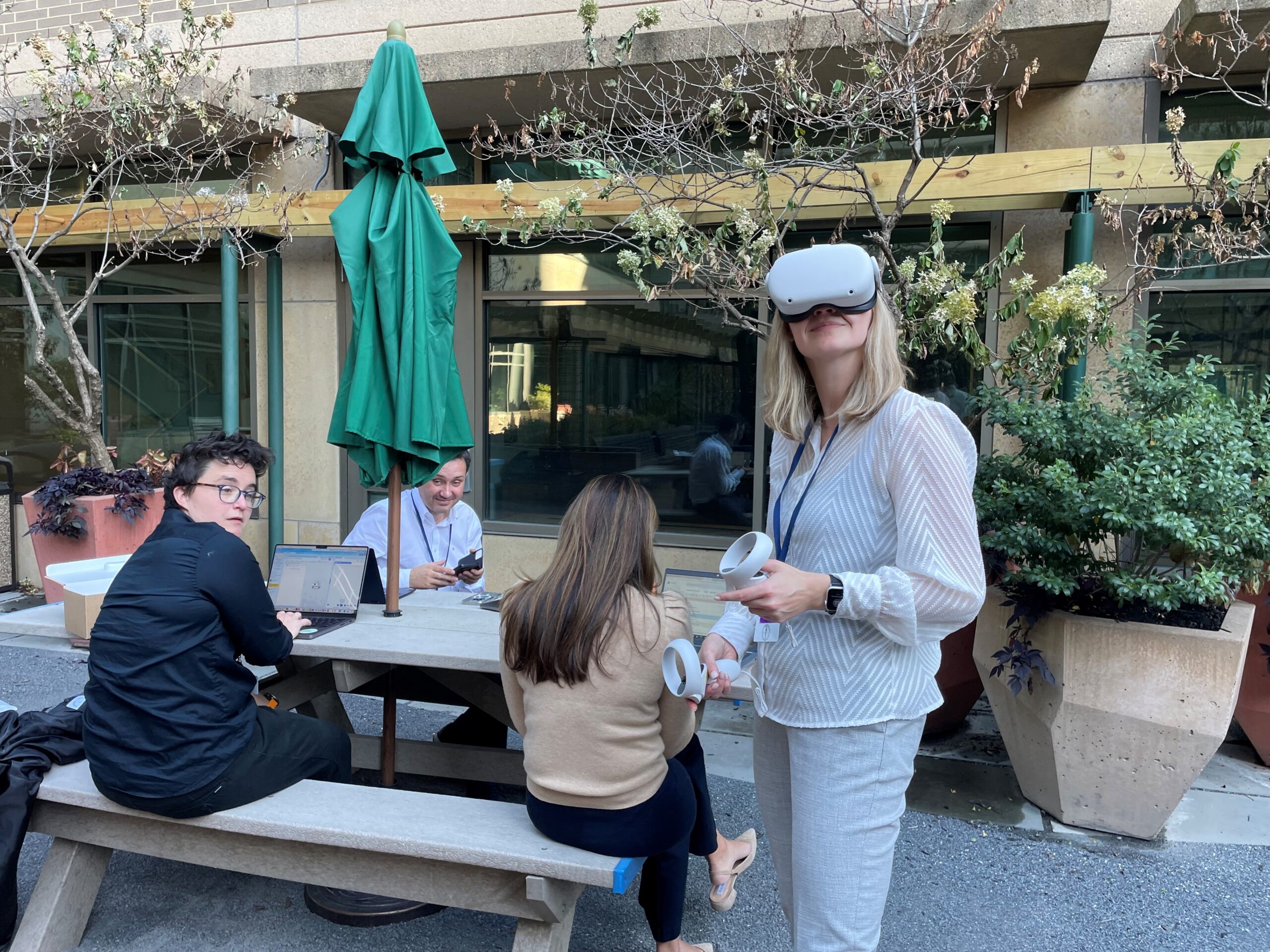
The eight fellows are divided between two research projects. One is developing an artificial intelligence (AI) model to grade medical students’ notes, while the other is designing a virtual reality-based simulation scenario to objectively assess communication among interprofessional teams of medical professionals.
“What I’ve enjoyed most about this fellowship is exploring new ideas with people who care about education as much as I do,” Nuno S. Osório, PhD, says. “Looking at emerging technologies like AI and VR, together with the fundamentals of learning and assessment, has pushed my thinking in ways I didn’t expect.”
As fully as the fellows embraced each other from the beginning, they took to their faculty mentors, Larry Gruppen, PhD, and Jennifer Kogan, MD, just as quickly and completely, which enabled them to trust their sage guidance before they fully understood it.
Nash says he came away from an early lecture about theoretical frameworks skeptical about the concept’s relevance to his work. Now he believes it’s brought everything into focus for him.
“I look for theoretical frameworks and I try to contextualize what I’m doing and what I’m writing about,” he says. “I feel like it’s the missing piece that I didn’t know was missing, providing a lens through which everything connects in a way it didn’t for me before.”
For all the skills Natascha Heise, PhD, has learned through the fellowship, she says the most important one is simply being more methodical.
“In the past, I often felt rushed when starting research projects, and as a result the methodology was sometimes underdeveloped,” she says. “But our mentors have really helped us to slow down and do the work before collecting data, and that is an invaluable skill that I’ve used as I mentor students who do research projects with me.”
This maturation, along with the fellows’ relentless curiosity, has led to a number of small studies the fellows have launched on their own, Heise says. While they’re split into two groups, there’s constant discussion among all of the fellows, creating a cross-pollination effect.
Gruppen and Kogan believe that all of the above will positively impact medical education.
“It’s an incredibly important investment in the community of medical educators to have people who have a greater appreciation for the quality of assessment, of research methodologies, of the science that comes out of the education that we try to produce,” Gruppen says. “I think NBME’s investment in this has been a major change in the larger environment, nationally.”
New career opportunities become apparent
Already, ripple effects are evident.
Laura Mulvey, MD, says she’s applying what she’s learning from working on the simulation research project to an interprofessional mobile simulation program.
“We’re countering the collapse of rural health care by building out our obstetrics education for a lot of the local critical-access hospitals that are closing, and I’m using the work from this project to buff up our assessment of it and the curriculum,” she says.
With the new data Mulvey has collected through these assessments, she’s begun applying for additional funding to grow the program. She and her team have also been invited to present their program in Vietnam.
What seemed like another steppingstone has now clearly become something more, a moment that matters in the burgeoning careers of these medical educators and researchers that are now starting to open up in ways they previously didn’t foresee.
Candace Pau, MD, has applied to a doctorate in health professions education program, noting that Gruppen and Kogan were “super-instrumental” in this process. She began her studies in January 2026.
Mariela Lane, MD, embarked on the fellowship with an interest in learning about assessment and a desire to better understand how high-quality evaluations are designed and used in medical education. More than a year later, “I’ve realized what a fascinating and complex field medical education assessment is,” she says, “and I’d really like to continue exploring it and building expertise.”
Lane also feels she’s gained a greater appreciation for NBME itself, which she viewed as an “adversary” while she was a medical student.
“As a student, you don’t realize how much effort goes into making these very well-written, effective test questions,” she says.
Now, when Lane’s students start feeling anxious about an upcoming unit exam, she tells them, rest assured, “a lot of work went into making the questions and they will be assessing you fairly.”
An ‘absolutely transformative’ experience
Over the last several months, Tama S. Thé, MD, has used the experience from this fellowship to explore how AI could improve health outcomes in his home state of Kentucky, where the life expectancy can vary by up to 10 years depending on zip code.
In one project, he’s using AI-powered smart pill bottles to improve compliance for Kentucky residents with hepatitis C taking prescribed medications. Another, a joint venture with the state of Kentucky, is using an AI voice agent to inform residents they’re due for various cancer screenings, describe the procedure, and with consent, schedule the screening. He says that this is just the beginning.
“We are using AI to unlock personalized care previously unimaginable for Kentuckians. We are overcoming barriers to access by extending the reach of human specialists with fundamentally transformative data-driven precision,” he says.
Learning to use AI language models for his SEEF research project, Thé says, provided him with the foundation upon which he’s developing these other AI platforms. “It probably seems silly that all of this started with, ‘Can we use a language model to grade medical students’ notes?’” he says. “By using AI to evaluate written clinical reasoning, we learned to apply natural language processing to clinical notes to extract insights at scale and build tools that improve both education and patient care.”
There’s a bit more to it than that because theirs wasn’t just any research project; it was hatched and executed through a highly rigorous and respected research fellowship. Their software may be far-reaching — time will tell. Regardless, the fellows themselves were shaped by what they accomplished.
“It’s absolutely transformative, this experience,” Thé says. “I can’t articulate just how different my life is because of this fellowship.”
The 2024 SEEF Cohort
Listed according to their research groups
Nayef Chahin, MD, MEd
Assistant professor of pediatrics, associate program director of the neonatal-perinatal fellowship and associate program director of the pediatrics residency program at the Virginia Commonwealth University School of Medicine
Christopher J. Nash, MD, EdM
Assistant professor of emergency medicine at the Duke University School of Medicine
Candace Pau, MD
Associate professor of clinical science at the Kaiser Permanente Bernard J. Tyson School of Medicine
Tama S. Thé, MD
Assistant professor of pediatric emergency medicine at the University of Kentucky College of Medicine
Natascha Heise, PhD
Assistant professor of anatomy at Macon and Joan Brock Virginia Health Sciences at Old Dominion University
Mariela Lane, MD
Assistant professor of internal medicine at the Paul L. Foster School of Medicine at Texas Tech University
Laura Mulvey, MD
Assistant professor and clerkship director of emergency medicine and the director of evidence-based practice at The Robert Larner, MD, College of Medicine at the University of Vermont
Nuno S. Osório, PhD
Assistant professor at the School of Medicine at the University of Minho